
Britannia
 Britannia
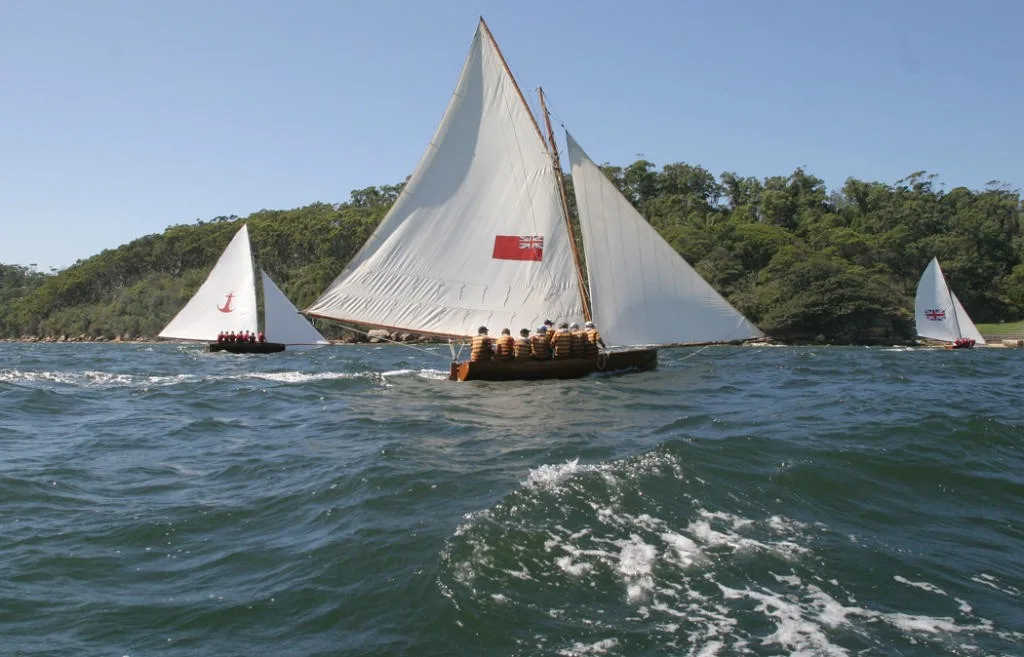
Replica of the 1919 skiff built, owned and skippered by “Wee Georgie” Robinson, the famous Balmain footballer; the restored original is on display at the Australian National Maritime Museum. The replica, the only true carvel planked replica in the fleet, was built by Ian Smith and launched in 2002.
The boat
- Original launched
- 1919
- Replica launched
- 2002
- Original builders
- Wee Georgie Robinson, assisted by his father Jack Robinson
- Original skippers
- Wee Georgie Robinson
- Former skippers
- Ian Smith
- Notable honours
- Won several national titles during a 25 year racing career.
- Dedication
- To “Wee” Georgie Robinson
- Jumpers
- Yellow and black horizontal stripes
- Beam
- 8 ft (2438 mm)
- Length
- 18 feet
- Boat weight
- 438.0 kg
- Rudder weight
- 20.5 kg
- Centreboard weight
- 35.5 kg
Balmain Rugby League (original design).
Status
- Status
- not recorded, awaiting the sailing committee
- Owner
- not recorded, awaiting the sailing committee
- Estimated annual cost
- not recorded, awaiting the sailing committee
The story
Britannia is the first of the post-World War I boats. It was built in 1919 by Wee Georgie Robinson in Balmain, assisted by his father, Jack Robinson.
Wee Georgie was not only a sailor. At 19 years old and 5 feet tall, he was a halfback for the Balmain Rugby League team, which won the premiership that year. They went on to win four more premierships. Georgie played for Metropolis, which was the state team. After retiring, he coached first and reserve grades for 35 years.
George was an accomplished sailor, having won 29 races in a 6-footer also called Britannia. Why Britannia? Remember that in 1919 virtually every Australian called themselves British. Technically there was no Australian citizenship until 1949, and patriotism probably played a big part in the name. Her sail insignia was the British Red Ensign, the merchant navy’s Red Duster, with the Union Jack in the corner and no Southern Cross; the Union Jack itself was used on other boats over the years, including Australia IV.
The first race was in October 1919, using a borrowed rig from another 18-footer, Livonia. It was unusual for an 18-footer to last more than a decade, but Britannia was the exception. It sailed for 25 years before having the rig removed, an engine fitted, and becoming a start launch. In the early 1980s Georgie, then in his 80s, started restoring Britannia. It was in very poor condition, and it was doubtful it would ever float again. Sadly, he died in 1987, but the boat found its way to the National Maritime Museum, where it is on display.
During the 1920s the racing was dominated by Wee Georgie and Chris Webb. They carried on a torrid struggle, with one skipper dominating one season and the other the next. Britannia remained competitive throughout its racing career and won several national titles.
The replica was measured and built from the restored original and from plans drawn by David Payne and Alan Payne. Ian Smith replicated the planking, timber selection and details of the original, and it is the only true carvel planked replica. Britannia carries a large 1919 sail plan and a crew of up to 14. For more information, see Ian Smith's book “The 18-Footer Britannia”.
The original Britannia has an entry in the register of 18-footers on The Open Boat, Ian Smith's record of the boats built before 1950, with its builder, insignia and racing history.
Videos


Books
The Open Boat
Ian Hugh Smith, 2017. Where the 18-footer came from and how the boats were built, by the boatbuilder who built the replica Britannia.
The 18-Footer Britannia
Ian Hugh Smith, 2020. The centenary history of the original Britannia, Wee Georgie Robinson's 18-footer, from her first race in 1919 to the museum.
Further reading on The Open Boat
The Open Boat is Ian Smith's site on Sydney's open racing boats. These articles are his.
Centenary of Britannia 1919-2019
A summary of Ian Smith's book on the original Britannia and the people around her.
Wee Georgie Robinson versus Chris Webb
The rivalry between Britannia's skipper and HC Press's in the 1920s.
You can sail this boat. Try sailing three times before joining; we provide the training. Start here.